Strengthening Community based Early Warning System (CbEWS) in Bagmati Flood Risk Communities at Rautahat and Sarlahi
Project Overview:
The Community-Based Early Warning System (CbEWS) Project, implemented by NEEDS Nepal in coordination with the Department of Hydrology and Meteorology (DHM) and supported by Asian Development Bank, is being carried out in flood-prone areas of Rautahat and Sarlahi districts. The project focuses on strengthening disaster preparedness and response capacities of vulnerable communities that are highly exposed to recurrent flooding and climate-induced hazards.
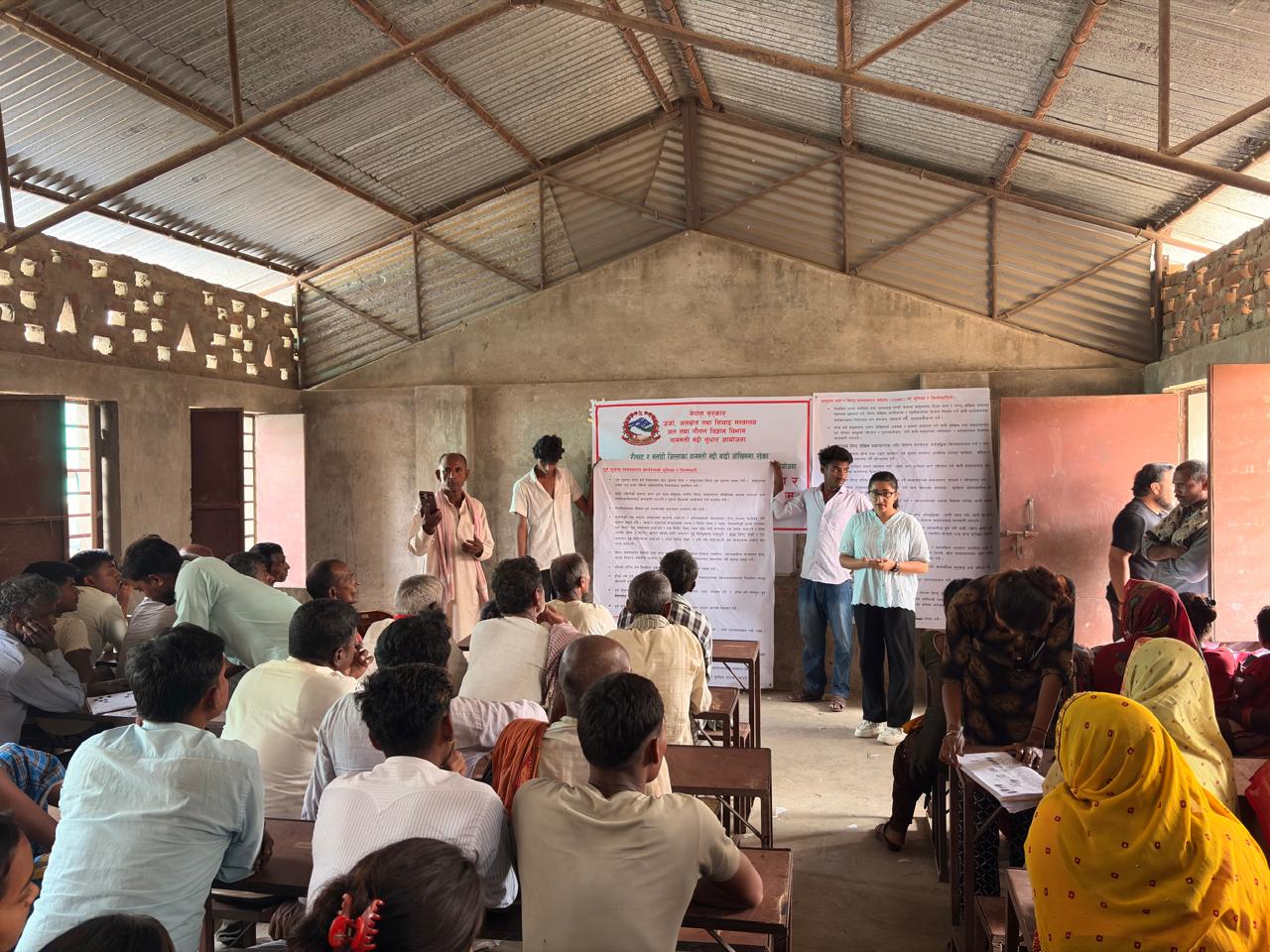
The project integrates scientific forecasting with indigenous knowledge systems to ensure timely, reliable, and effective early warning dissemination. It prioritizes community ownership by forming and strengthening Community Disaster Management Committees (CDMCs) and task forces, enabling them to lead early warning dissemination, preparedness planning, and emergency response actions. These communities often face significant risks due to limited access to early warning information, weak institutional coordination, and high exposure to disasters.
The overall goal of the project is to ensure that vulnerable communities live in a safer and more resilient environment where risks from floods and other hazards are minimized through timely early warning, improved preparedness, and coordinated response mechanisms.
Project Objectives:
The key objectives include strengthening community-based early warning systems by improving risk knowledge through Hazard, Vulnerability, and Capacity Assessments (HVCA), enhancing real-time monitoring and forecasting linkages with technical agencies, establishing effective multi-channel communication systems for last-mile warning dissemination, building the capacity of CDMCs and community task forces on preparedness and emergency response, and institutionalizing CbEWS within local government systems for long-term sustainability.
Expected Key Results:
- Formation and strengthening of Community Disaster Management Committees (CDMCs) and task forces across 25 targeted communities.
- Conduct Hazard, Vulnerability, and Capacity Assessments (HVCA) to identify risks, vulnerable populations, evacuation routes, and safe shelters.
- Installation of 4 River Level Sensors (RLS) integrated with Compact Data Collection Platforms (CDCP) for real-time upstream water level monitoring.
- Development of a comprehensive Community-Based Early Warning System (CbEWS) manual to document best practices, tools, and methodologies for effective replication and scaling in other river basins of Nepal.
- Establishment of multi-channel early warning dissemination systems including SMS alerts, sirens, volunteers, and megaphones.
- Strengthened upstream–downstream communication mechanisms for timely information flow.
- Capacity building of community members on early warning interpretation, evacuation procedures, search and rescue, and first aid.
- Conduct regular simulation exercises and mock drills to test and improve system functionality.
- Integration of CbEWS into local disaster risk management plans and policies for sustainability and local ownership.
Project Details
| Status: | Ongoing |
| Duration: | November, 2025 - October, 2026 |
| Province: | Madhesh Province |
| District: | rautahat, sarlahi |
| Municipality: | Rautahat Palikas: Bagmati Municipality, Rajdevi Municipality, Durga Bhagwati Rural Municipality, Madhav Narayan Municipality, Gadhimai Municipality, Brindawan Municipality, Chandrapur Municipality Sarlahi Palikas: Barathawa Municipality, Basbariya Rural Municipality, Dhankaul Rural Municipality, Ramnagar Rural Municipality, Balara Municipality |
| Beneficiaries: | 3465 |
Funding Partner
Asian Development Bank(ADB)
Technical Partner
Department of Hydrology and Meteorology